Thursday, May 31, 2012

Leonidas' Surgery - Part Two

Well, after taking apart the motor and the foot pedal, it was time to start disassembling the rest of the machine.  I decided that since his innards do turn easily I am not going to completely disassemble him, however I am taking him apart.

So, every part that can be removed has now been removed, and this is a brief synopsis of how I did that.

DISCLAIMER:  Again, I do not intend for this to be a comprehensive tutorial, nor am I giving any advice here.  I am simply sharing MY experience.  I am not doing anything that I am uncomfortable doing, I know the risks I am taking and IF I screw this up, I'm "OK" with that.


The Hand Crank is the largest piece still attached to the block (the term for
the main body of the Machine) so I decided to start there.
One little Screw and the knob slipped right off.  Notice how badly pitted the
chrome is here.  Nor sure yet what I am going to do about that...
I took many, many pictures like this.  A part that needed to come off was
moved slightly, a photograph taken so I can see how it was when I
removed it, so I know how to put back together again!
Next was the Bobbin Winder assembly.  A simple screw holds the arm in
place.  Easy to remove, BUT, I am having a hard time figuring out how
to remove the wheel from the arm.  It HAS to come off as the arm needs
to be refinished and the wheel needs to be refinished.  The wheel is
supposed to be chromed, you see how rusted it is...
Large Bronze "screw" next to the spool post.  I removed this piece only to
realize what it is...  It is a PIN that keeps all of the innards aligned properly!
LUCKILY, I realized this and with the help of my son, lined everything inside
back up and got this bad boy back in place before things got whacky in there!!
 
Stitch Regulator Arm
Stitch Regulator Face plate.  I am thinking of stripping off the black paint
and redoing it with Maroon... Not sure though... We'll see.  I've got time.
Face Plate Removed.  This is the only Chromed
piece that is half decent.  All of the other chromed
or "silver" pieces all look terrible.  Not sure what
I am going to do about this yet... Suggestions?
Part of the threading assembly, again, looks bad.
Foot Presser rods, lifter and needle rod.

Removal of the Presser Rod was a little tricky
due to the spring you see here near the bottom
of the rod.  Due to the spring I could not lift the
assembly through the hole at the top.
Putting this part back together is going to be
interesting...
The completely removed presser foot rod.
The thread take up lever.  Again, looks horrible,
but I can't get it off to refinish it.  It looks like two
simple machine screws, but they won't budge.

So, next is the thread take up lever, the tension assembly and the needle rod and then I think I will be ready to start stripping this bad finish and preparing him for the "Ultimate Makeover".

I haven't been doing much quilting lately because my wife and I have decided to put our home on the market and we are looking to buy a larger home.  Much of my time has been spent preparing our home for market.  It's amazing how much STUFF accumulates over 15 years!  Watch for a blog post about my sewing "Space", which is nothing more than storage space in my garage.  But since I am now cleaning it out and organizing and deciding what I need for the next four to six months and what can go into storage, I am realizing how much Quilting Stuff I have!

I have been able to squeeze 15-30 minutes here and there to work on Leonidas, but sewing requires set up and tear down, etc. so for now, Leonidas is going to have to suffice to satisfy the creative spirit in me.  Thus far, he has...

As Always, Thanks for Reading...

Until Next Time,
Paul


Wednesday, May 30, 2012

Leonidas' Surgery - Part One

In case you missed it in the comments on my last "Spartan" post, my good friend Jimmy declared the "Spartan's Name should be 'Leonidas', King of Sparta!"

And so it is that my Singer Spartan now has a name and his name is "Leonidas".

Since my last post, I have been oiling him daily, hand turning his workings a few times and then running him for a minute or so.  On the third day he started to spin with no hesitation and was churning away when I started to smell something burning.  I stopped and looked at the motor and saw a bit of smoke rising out of it.  So I unplugged him and decided I would not run it again until I had a chance to open up the motor housing and clean it out.

The next day, I attacked the first part of my refurbishment - The Motor.

Let me start by saying, I am NOT AN EXPERT.  I know a enough about how an electric motor works that I am comfortable opening this up.  (Not to mention, if I destroy it, it can be replaced for less than $20).  I am sharing the process and what I have learned along the way... This is NOT A TUTORIAL.  Just my experience.

I took a lot of photos and a lot of verbal notes along the way, so I can reassemble by printing the photos and listening to my notes in reverse order...

Here is a photo journey of the dis-assembly and cleaning of Leonidas' motor.

The Motor
Mount Side of Motor
After removing the Belt Wheel and two nuts the back half of the
Motor Housing slipped right off exposing the innards of the motor.
Pictures like this help me remember where the small
bits go when it comes time to re-assemble.

A goopy motor fan, which I promptly cleaned up.
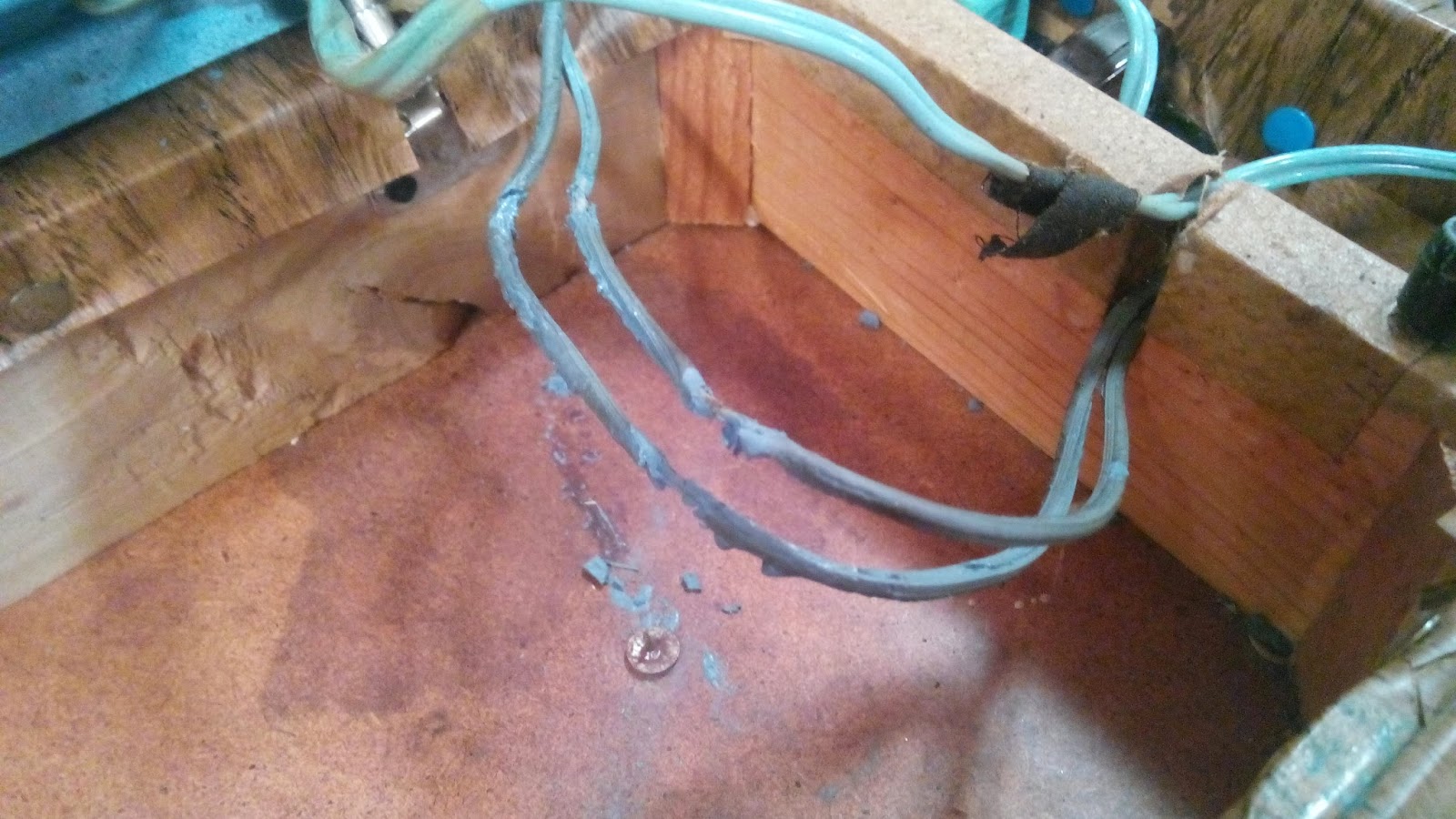
When I started cutting wires, I started marking wires and taking good
notes.  This is the only way I will feel comfortable putting it back together.
This little piece is curved and it holds the bearing in place for the motor
shaft.  It came out fairly easily, but putting it back in is going to be tricky.
I am pretty sure they made a tool specifically for this task that I don't own...
The foot pedal is in such poor condition I had to refinish it.  Unfortunately
in taking it apart, I had to cut off the pin you see on the right.  That pin
is like a rivot, except it is about 1.25 inches long with a smaller tip on the
end that is curled around the support pillar to mount the whole thing in
place.  With it cut, there is no replacing it.  I am going to have to find an
innovative way of fixing this little problem...
All of the "Little Parts", each covered in goo.
After cleaning all of the "little parts" with Goo-Gone my hands were
all white.  I had never had this happen with Goo-Gone in the past, but
then it struck me, "I don't usually use an eighth of a bottle at one time."
Next time, I'll wear gloves!!

So, that's it.  The motor and the foot pedal are completely disassembled and ready to be stripped.

I have decided not to go back to the original black.  I am going to build a "Theme Machine" to go along with his new name.  "Leonidas" was king of the Spartans.  His shield was made of hammered bronze and his cape was Maroon.  So, I am going to paint the machine with a hammered bronze paint and I am going to design some decals to go along with the theme.  The "Spartan" name badge will be replaced with "Leonidas" in a Greek font, and while the Spartan was sparse on decals, I am going to deck him out with some chains, a spear or two and maybe a Flail or two.  Right in the middle of the deck I am going to put a shield of some sort.

Let the fun begin!!

Until Next Time,
Paul

Friday, May 25, 2012

Hanging Stuff Advice...

You know how every now and then you hear an idea and you think "DUH!!! Why didn't I think of that!"  Well, prepare yourself.  Most of you are probably about to do that at least once...  (Don't get me wrong, I'm not trying to be a smart alec, I had the same reaction when I saw the first part of this tip several years ago, and again last week.  But I had to try it first...)

When hanging a picture I have often used a post it note rather than putting a mark on the wall.  This serves two purposes.  First, I can "move my mark" without leaving the first mark on the wall... Second, I can SEE the mark from across the room, so I can make sure that I really want to hang whatever I am hanging where I have placed my mark.

Laser level is the height for my mark.  The point on the Post It Note
is the center.  This photo taken from 6 feet away and the mark is easily
seen against the bright yellow post it note.  I can even see the mark
from 10 or 12 feet away!
I saw that trick years ago and haven't put a mark on my wall since.  But the other day I got an email with all sorts of little "Home Remedies" for common "Problems".  I saw in their photo a Post It hanging on a wall and I thought "I do that!"  But then I noticed that the Post It was folded and as I read the paragraph, I realized they weren't using the Post It to mark a spot on a wall.  They were showing to use a Post it to catch the drywall dust when you drill the hole in the wall!

Their advice was to place a Post It note UNDER the spot
where you are about to drill and FOLD it to catch the
falling dust...  My Folded Post It note with my "mark"...

The contents of my folded Post It note after drilling, etc.

My Floor, AFTER drilling a hole in the drywall to hang a piece of art...
Notice there is NO dust on the air return grate, the baseboard or the floor!!
SO, for the past 10 to 12 years I have been using a Post It note to mark my spot and then watching all of the dust fall right over the Post It to the floor, then dragging out the vacuum cleaner to clean up the mess when ALL I HAD TO DO WAS FOLD MY POST IT NOTE!!!  Why didn't I THINK of that!!

Boy did I feel silly, but now I know!  And so do you!

Until Next Time,
Paul